The Role of WebAssembly and JavaScript APIs in Building Powerful Browser-Based Tools
Modern web browsers have evolved dramatically in the last decade. What was once a simple tool for viewing websites has now become a powerful platform capable of running complex applications directly inside the browser.
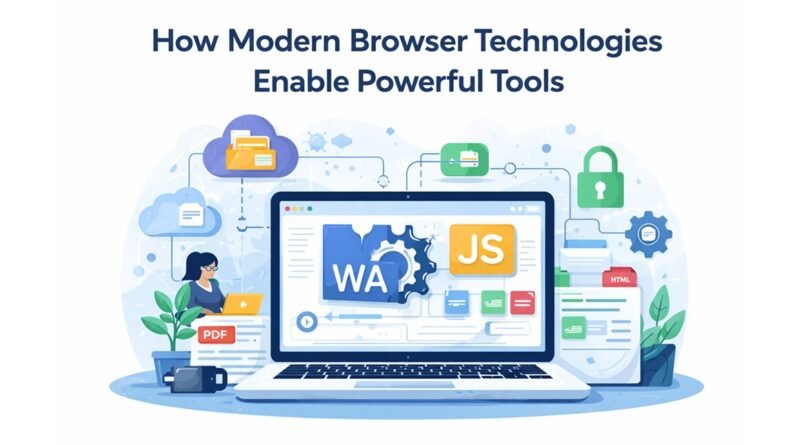
Technologies such as WebAssembly, advanced JavaScript APIs, and browser-based file handling systems allow developers to create fast and secure web tools that run entirely on the user’s device. These technologies power many modern utilities including document processing tools, image converters, financial calculators, and productivity applications.
Because these tools operate directly within the browser, they provide better performance, improved privacy, and faster results compared to traditional server-based applications.
WebAssembly: Bringing Near-Native Performance to the Browser
WebAssembly (often called Wasm) is one of the most important technologies driving the new generation of web applications.
It allows developers to run code written in languages like C, C++, and Rust inside the browser at speeds close to native applications. This capability makes it possible to perform complex tasks such as:
- document compression
- image processing
- file conversions
- data analysis
For example, modern document utilities like
PDF Tools
https://bharatarticles.com/pdf-tools
can compress or split PDF files directly in the browser without requiring users to upload their documents to remote servers.
This approach improves both speed and privacy because the processing happens locally on the user’s device.
Advanced JavaScript APIs Enable Powerful Web Applications
In addition to WebAssembly, modern browsers also provide a wide range of JavaScript APIs that allow websites to interact with files and perform advanced tasks.
Some commonly used browser APIs include:
- File API for reading and managing local files
- Canvas API for image editing and manipulation
- Streams API for handling large files efficiently
- Clipboard API for quick data transfer
These APIs allow developers to create sophisticated browser-based tools.
For example, users can process images directly on their device using
JPEG Image Tools
https://bharatarticles.com/page/jpeg-image-tools
This eliminates the need to upload images to remote servers and ensures better privacy.
Browser File Handling and Local Processing
Another important advancement in web technology is improved file handling inside the browser.
Modern browsers allow applications to temporarily process files locally while maintaining high performance. This capability enables many tasks such as:
- compressing documents
- converting images
- editing files
- performing calculations
Because the processing happens locally, users retain full control over their data.
Financial and Utility Tools Powered by Browser Technology
Browser-based technologies are not limited to document processing. They also power a variety of useful everyday tools.
For example, users planning a loan can quickly calculate their monthly payments using the
EMI Calculator
https://bharatarticles.com/page/emi-calculator
Investors who want to estimate long-term wealth growth can use the
SIP Calculator
https://bharatarticles.com/page/sip-calculator
Similarly, individuals saving for long-term government investment schemes can evaluate returns using the
PPF Calculator
https://bharatarticles.com/page/ppf-calculator
All of these utilities run instantly inside the browser without storing user data externally.
Everyday Browser Utilities
Modern browser technology also powers many smaller utilities that people use daily.
For instance, users can determine their exact age using the
Age Calculator
https://bharatarticles.com/page/age-calculator
Web designers and developers can convert different color formats using the
Color Converter
https://bharatarticles.com/page/color-converter
These tools rely on lightweight JavaScript logic that runs instantly in the browser.
Advantages of Browser-Based Tools
The use of technologies like WebAssembly and modern JavaScript APIs offers several advantages:
- faster performance compared to server-based tools
- improved privacy because files remain on the user’s device
- reduced dependence on cloud servers
- instant processing without uploads
- better user control over personal data
These benefits are driving a growing trend toward client-side web applications.
The Future of Web Applications
As browser technologies continue to evolve, the capabilities of web applications will expand even further. Developers are increasingly building powerful applications that run directly inside the browser, including:
- document editors
- media processing tools
- design applications
- financial planning utilities
This shift toward browser-based computing is transforming how users interact with digital tools.
Conclusion
Technologies such as WebAssembly, advanced JavaScript APIs, and browser file handling systems have transformed modern web browsers into powerful computing platforms.
These technologies enable fast, secure, and privacy-friendly applications that run directly on the user’s device. From document tools like
PDF Tools
https://bharatarticles.com/pdf-tools
to investment utilities such as the
SIP Calculator
https://bharatarticles.com/page/sip-calculator
modern browser-based tools demonstrate the immense potential of today’s web technologies.
As these technologies continue to improve, browser applications will become even more powerful and widely used in everyday digital tasks.
